




The Notebook Habit: Analogue Thinking in a Digital World
 876 views
 2 min read28 Jun 2026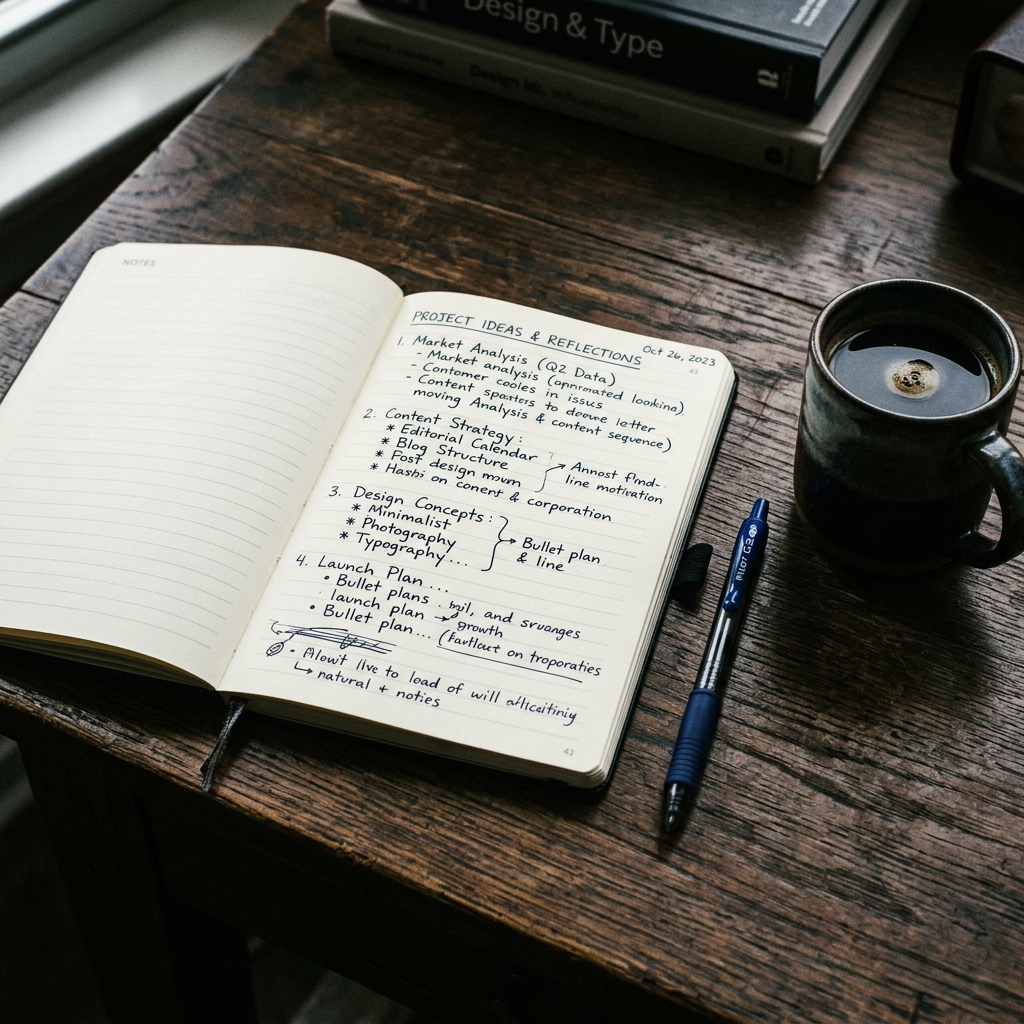
Six months ago I bought a Leuchtturm1917 and a Pilot G2 and made a rule: every idea that mattered had to pass through paper before it went anywhere digital. I didn’t expect it to change how I work. It did.
Why Paper at All?
There is a frictionlessness to digital tools that can be counterproductive. Notion pages can be restructured in seconds. Figma frames can be multiplied infinitely. When everything is editable, nothing feels committed. Ideas live in a state of perpetual draft.
Paper has friction. You can’t undo. You can’t duplicate with Command-D. You can’t search for something you half-remember. These limitations force you to be more deliberate — to actually think before writing rather than thinking by writing and deleting and writing again.
What Changed
The first thing I noticed was the quality of my morning thoughts. Before the notebook, I would open my laptop and immediately start responding to whatever was urgent. The urgent always won.
With the notebook, I started spending fifteen minutes before the screen: reviewing what I was working on, sketching rough ideas, writing observations about things I’d noticed. By the time I opened a design tool, I had something to bring to it.
The second thing I noticed was that ideas surfaced differently. When I’m designing digitally, I tend to iterate in one direction — I start with an idea and refine it. On paper, I’m more likely to take a left turn, cross something out, draw an arrow to a completely different thought. The messiness of the medium seems to unlock a different kind of thinking.
The System I Settled On
After a few chaotic months, I developed a loose structure:
Morning pages (10 min): Freeform. Whatever is on my mind. No editing. Often incoherent. Surprisingly useful.
Project spreads: Two facing pages per project. Left side: constraints and non-negotiables. Right side: ideas, sketches, questions. Updated whenever I sit down to work on that project.
End-of-day review (5 min): One sentence about what I made progress on, one question I’m still sitting with. This single habit improved my memory of my own work dramatically.
Weekly sweep: Everything from the week gets reviewed. Anything worth keeping moves to Notion or a reference system. Everything else is acknowledged and left.
On Losing Ideas
People often ask: what if you lose the notebook? Doesn’t that feel risky?
Yes. And I think that’s fine.
If an idea is truly important, it will survive without the notebook. If it doesn’t survive, maybe it wasn’t as important as I thought. There’s something clarifying about a storage medium you can’t search. It forces you to only keep what is genuinely useful.
A Note on Pens
The G2 is correct. This is not up for debate.